
Nupave recommended external concrete specification — Patterson Lakes
Group 1 — Bayside / Sand Belt — Brighton Group Sands
Concrete: N25 or N32 (depending on application)
Indicative regional ground conditions
Patterson Lakes sits on the Bayside / Sand Belt, where the natural profile is dominated by free-draining Brighton Group sands. Regional ground conditions are generally stable and low-reactivity, though loose sand pockets can require additional compaction. The actual AS 2870 site classification for any individual property can only be established through a site-specific geotechnical investigation, taking into account soil profile, fill, moisture conditions and vegetation.
Regional ground movement (indicative, AS 2870)
Ground of this type may exhibit generally low seasonal surface movement (indicatively under 20 mm). This is a regional indicator only — actual movement at a given address depends on soil profile, moisture history and tree influence.
| Application | Slab thickness | Sub-base | Reinforcement |
|---|---|---|---|
| Path / foot traffic | 75–100 mm | 50–75 mm compacted crushed rock | SL72 |
| Driveway (cars up to 3 t) | 100 mm | 75–100 mm compacted crushed rock | SL72–SL82 |
| Occasional truck (3–10 t) | 125–150 mm | 100 mm compacted crushed rock | SL82 or rebar |
Nupave standard specification for typical conditions of this soil group — subject to site-specific assessment. Not a design substitute for a project engineer’s report where one is required.
| Saw-cut / control joint spacing (100 mm slab) | |
|---|---|
| Spacing between cuts | 2.7 m – 3.0 m (standard spacing) |
| Cut depth & timing | At least 25 mm on a 100 mm slab (¼ slab thickness). Saw-cut as soon as the concrete can be cut without excessive ravelling — timing will vary with the mix, weather and saw type. A quick trial cut on a low-visibility edge or offcut is best practice before committing to the full grid. |
| What joints do | Closer joint spacing and properly proportioned panels encourage drying-shrinkage and thermal movement to occur at planned locations. Control joints reduce the risk of random cracking; they do not prevent cracking caused by inadequate support or differential ground movement. |
| Panel shape | Keep panels close to square (length ≤ 1.5× width). Long, narrow panels are more prone to random cracking regardless of joint spacing. |
Concrete grade
Nupave specifies N25 or N32 concrete depending on the intended application, anticipated loading, exposure conditions, selected finish and any site-specific engineering requirements. N32 may be specified where increased compressive strength, abrasion resistance or durability is required. Concrete strength alone does not compensate for inadequate subgrade preparation, drainage or ground movement — it is one element within a properly detailed slab system.
Slip layer (poly membrane)
A polyethylene separation or slip membrane may be considered where required by the slab design or site conditions. It can reduce friction between the slab and compacted base during concrete shrinkage, but does not prevent settlement, heave or other vertical ground movement. Where a project engineer or geotechnical report specifies membrane use, that specification takes precedence.
Sub-base — why it’s a key part of the quote
Correct excavation, drainage, and a uniformly compacted crushed-rock base significantly reduce settlement and provide consistent support under the slab. It adds cost — both in laying and compacting the base, and in the extra excavation and spoil-removal that comes with the deeper dig — but that preparation is what a slab needs to perform over the long term. The preparation actually required may vary where uncontrolled fill, soft areas or unsuitable material are encountered on the specific site.
Curing coat
Concrete requires curing to develop its full design strength and durability. A liquid curing coat is applied after finishing, once bleed water has disappeared and in accordance with the manufacturer's requirements. It seals moisture into the concrete so hydration continues over the first 7 days — when the concrete's real strength develops. In summer, hot dry weather removes surface moisture quickly, so curing coat is essential to prevent surface crazing and reduced final strength. In winter, lower temperatures slow hydration, so curing is still required to reach design strength — the curing coat is still applied, and duration may need to be extended. Nupave applies curing coat as standard on all pours year-round.
Microfibres in concrete mix Optional add-on
What fibres actually do. Microfibres (polypropylene) get mixed through the whole pour and mainly control plastic shrinkage cracking in the first 24 hours, plus improve abrasion / impact resistance — they don’t add real structural tensile capacity. Macrofibres (heavier synthetic or steel) go further, adding post-crack toughness and some flexural strength.
Genuine benefit as an add-on: reduces fine / hairline shrinkage cracking and improves durability on any slab, sand or clay.
Should NOT replace mesh on soft or highly plastic clay soils: fibres provide no real resistance to the larger, ground-movement-driven cracks that mesh or rebar controls.
Salt / coastal exposure
Suburbs within roughly 1 km of Port Phillip Bay are subject to salt spray. Nupave uses B1 exposure classification (N32 minimum) and increases concrete cover to reinforcement on foreshore-proximate work to protect against saline-induced corrosion.
Important: This is Nupave’s enhanced standard specification for typical conditions in this suburb group, and is presented as a general reference. It is not a site-specific engineering design. Actual specifications for any individual property may vary based on site conditions, uncontrolled fill, tree influence, drainage, or requirements identified in a site-specific geotechnical or engineer’s report. Where an engineered design has been prepared for the site, that design takes precedence.
Concreting in Patterson Lakes
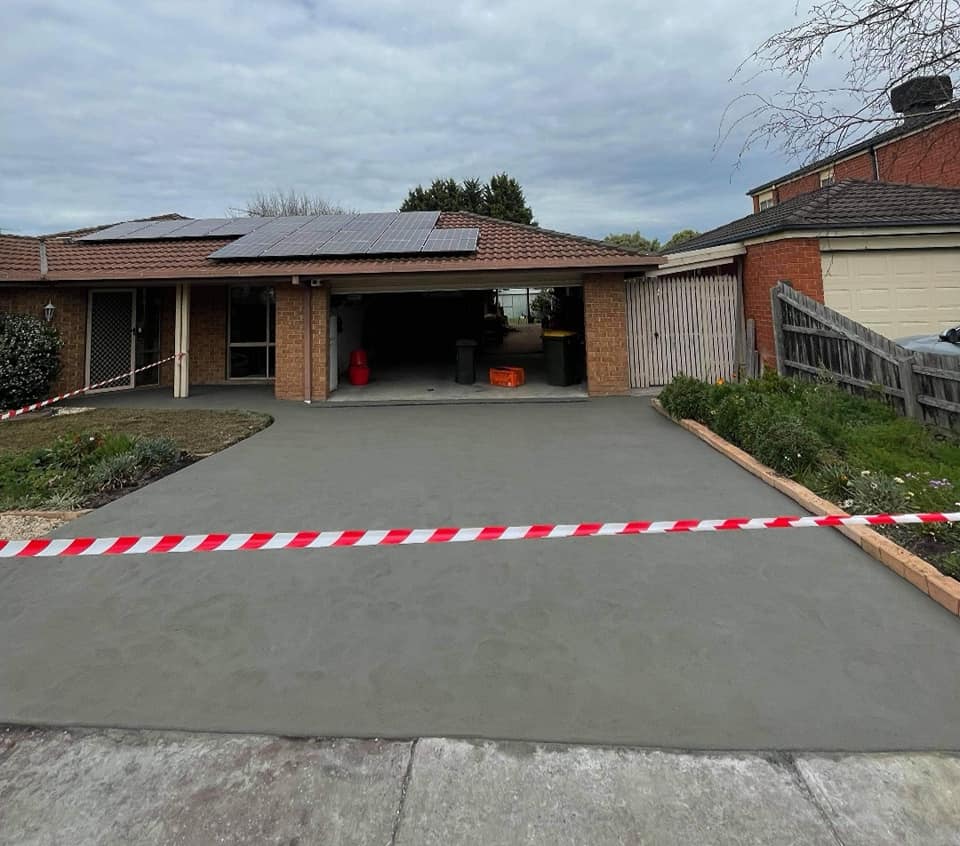
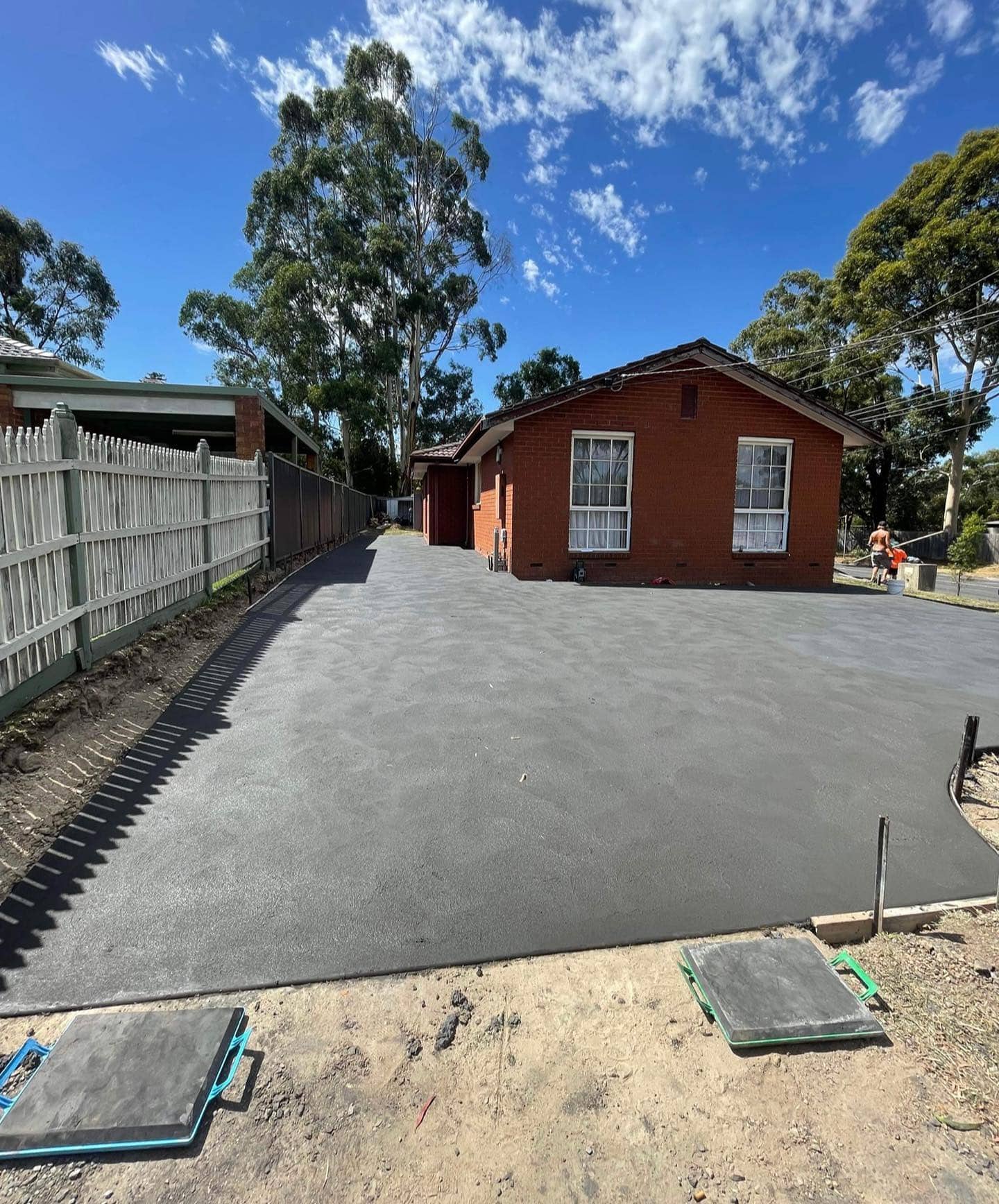
We pour new concrete across Patterson Lakes — driveways, paths, slabs and entertaining areas — building each one for the site so it doesn’t crack or heave down the track. In an area like Patterson Lakes, a new driveway is part of the home’s value — so we get the site classification, base and reinforcement right before a single barrow is poured. Every site is different, so below is what shapes how we approach concreting in Patterson Lakes.
Where we pour driveways and slabs in Patterson Lakes
As a planned canal estate suburb ~30km south-east of Melbourne CBD in the City of Kingston, Patterson Lakes is an area we cover regularly. Our crews are often pouring new concrete in Patterson Lakes, near Patterson River (tidal inlet), Patterson Lakes marina and canal network and Carrum Downs Recreation Reserve (nearby).
Life in Patterson Lakes is busy. In the waterways precinct, you probably don’t want to spend every weekend maintaining your outdoor surfaces. That’s where concrete wins—it’s built for low maintenance, letting you enjoy your property rather than work on it.
Set It and Forget It
Cleaning: Occasionally sweep your concrete surface and rinse with a hose to remove leaves, pollen, and general grime. That’s it—no scrubbing required for normal upkeep.
No sealant cycle: Some materials demand annual sealing treatments. Concrete doesn’t. Modern concrete, properly finished, resists water and UV damage without ongoing protective applications. That saves you both time and money.
Built to endure: Unlike timber that rots, splinters, and warps, or pavers that settle and create hazards, concrete simply endures. The sandy soil conditions here provide good drainage, which helps concrete perform well over time. With proper installation on your waterfront and canal homes, you’re looking at decades of service.
Grey or Coloured—Same Low Maintenance
Standard grey concrete requires no special maintenance, and neither does coloured concrete. Both are durable, both resist Melbourne’s weather, and both look fresh with minimal effort. Property owners throughout Patterson Lakes, Carrum Downs, Seaford and Bonbeach, and similar areas have made this discovery.
Quality Installation Matters
Low maintenance starts with proper installation. Whether it’s a residential driveway or a commercial concrete project, Nupave has the experience to deliver quality results. We ensure the foundation is solid and finishes are appropriate for long-term durability in the unique canal community with boat access to the bay environment of Patterson Lakes.
Does your concrete need replacing? If your concrete has developed cracks, become uneven, or just looks tired, you have options. Significant damage calls for replacement—a fresh pour resets your maintenance clock. If the structure is intact but appearance is the issue, resurfacing is the smart, economical choice.
Learn more at Nupave about low-maintenance concrete for your Patterson Lakes property.
Concrete Services in Patterson Lakes
Frequently Asked Questions
What preparation is needed before pouring concrete?
Good preparation is critical. We excavate to the correct depth, compact the subbase, install formwork and reinforcement mesh, and ensure proper drainage. In Patterson Lakes where sandy soil soil is common, proper subbase preparation is especially important.
How much does concrete cost compared to pavers?
Concrete is generally more cost-effective than pavers, especially for larger areas like driveways. It also requires less ongoing maintenance, making it better value long-term for Patterson Lakes properties.
Is sandy soil a concern for concrete foundations?
Sandy soil drains well, which is good for concrete. However, it can shift if not properly compacted. We ensure a solid compacted base before pouring to prevent settlement issues.
Patterson Lakes homes sit right on the waterways, so every slab here is dealing with damp, salt and boat traffic. Our concrete resurfacing in Patterson Lakes is built for that environment. Part of the City of Kingston.