
Nupave recommended external concrete specification — Heathmont
Group 2 — Eastern Ridge — Silurian Reactive Clay
Concrete: N25 or N32 (depending on application)
Indicative regional ground conditions
Heathmont is part of the Eastern Ridge belt, where the natural profile commonly contains Silurian shrink-swell clay. Regional conditions suggest reactive clay may be present on many sites, though individual property conditions vary. The actual AS 2870 site classification for any individual property can only be established through a site-specific geotechnical investigation, taking into account soil profile, fill, moisture conditions and vegetation.
Regional ground movement (indicative, AS 2870)
Ground of this type may exhibit around 40–60 mm of characteristic surface movement between wet and dry seasons on more reactive sites. This is a regional indicator only — actual movement at a given address depends on soil profile, moisture history and tree influence.
| Application | Slab thickness | Sub-base | Reinforcement |
|---|---|---|---|
| Path / foot traffic | 100 mm | 75–100 mm compacted crushed rock | SL72 (SL82 recommended) |
| Driveway (cars up to 3 t) | 100–125 mm | 100 mm compacted crushed rock | SL72–SL82 |
| Occasional truck (3–10 t) | 150 mm | 100–150 mm compacted crushed rock | SL82 or rebar |
Nupave standard specification for typical conditions of this soil group — subject to site-specific assessment. Not a design substitute for a project engineer’s report where one is required.
| Saw-cut / control joint spacing (100 mm slab) | |
|---|---|
| Spacing between cuts | 2.0 m – 2.4 m (tighter than the standard 2.7–3.0 m on stable ground) |
| Cut depth & timing | At least 25 mm on a 100 mm slab (¼ slab thickness). Saw-cut as soon as the concrete can be cut without excessive ravelling — timing will vary with the mix, weather and saw type. A quick trial cut on a low-visibility edge or offcut is best practice before committing to the full grid. |
| What joints do | Closer joint spacing and properly proportioned panels encourage drying-shrinkage and thermal movement to occur at planned locations. Control joints reduce the risk of random cracking; they do not prevent cracking caused by inadequate support or differential ground movement. |
| Panel shape | Keep panels close to square (length ≤ 1.5× width). Long, narrow panels are more prone to random cracking regardless of joint spacing. |
Concrete grade
Nupave specifies N25 or N32 concrete depending on the intended application, anticipated loading, exposure conditions, selected finish and any site-specific engineering requirements. N32 may be specified where increased compressive strength, abrasion resistance or durability is required. Concrete strength alone does not compensate for inadequate subgrade preparation, drainage or ground movement — it is one element within a properly detailed slab system.
Slip layer (poly membrane)
A polyethylene separation or slip membrane may be considered where required by the slab design or site conditions. It can reduce friction between the slab and compacted base during concrete shrinkage, but does not prevent settlement, heave or other vertical ground movement. Where a project engineer or geotechnical report specifies membrane use, that specification takes precedence.
Sub-base — why it’s a key part of the quote
Correct excavation, drainage, and a uniformly compacted crushed-rock base significantly reduce settlement and provide consistent support under the slab. It adds cost — both in laying and compacting the base, and in the extra excavation and spoil-removal that comes with the deeper dig — but that preparation is what a slab needs to perform over the long term. The preparation actually required may vary where uncontrolled fill, soft areas or unsuitable material are encountered on the specific site.
Curing coat
Concrete requires curing to develop its full design strength and durability. A liquid curing coat is applied after finishing, once bleed water has disappeared and in accordance with the manufacturer's requirements. It seals moisture into the concrete so hydration continues over the first 7 days — when the concrete's real strength develops. In summer, hot dry weather removes surface moisture quickly, so curing coat is essential to prevent surface crazing and reduced final strength. In winter, lower temperatures slow hydration, so curing is still required to reach design strength — the curing coat is still applied, and duration may need to be extended. Nupave applies curing coat as standard on all pours year-round.
Microfibres in concrete mix Optional add-on
What fibres actually do. Microfibres (polypropylene) get mixed through the whole pour and mainly control plastic shrinkage cracking in the first 24 hours, plus improve abrasion / impact resistance — they don’t add real structural tensile capacity. Macrofibres (heavier synthetic or steel) go further, adding post-crack toughness and some flexural strength.
Genuine benefit as an add-on: reduces fine / hairline shrinkage cracking and improves durability on any slab, sand or clay.
Should NOT replace mesh on soft or highly plastic clay soils: fibres provide no real resistance to the larger, ground-movement-driven cracks that mesh or rebar controls.
Important: This is Nupave’s enhanced standard specification for typical conditions in this suburb group, and is presented as a general reference. It is not a site-specific engineering design. Actual specifications for any individual property may vary based on site conditions, uncontrolled fill, tree influence, drainage, or requirements identified in a site-specific geotechnical or engineer’s report. Where an engineered design has been prepared for the site, that design takes precedence.
Concreting in Heathmont
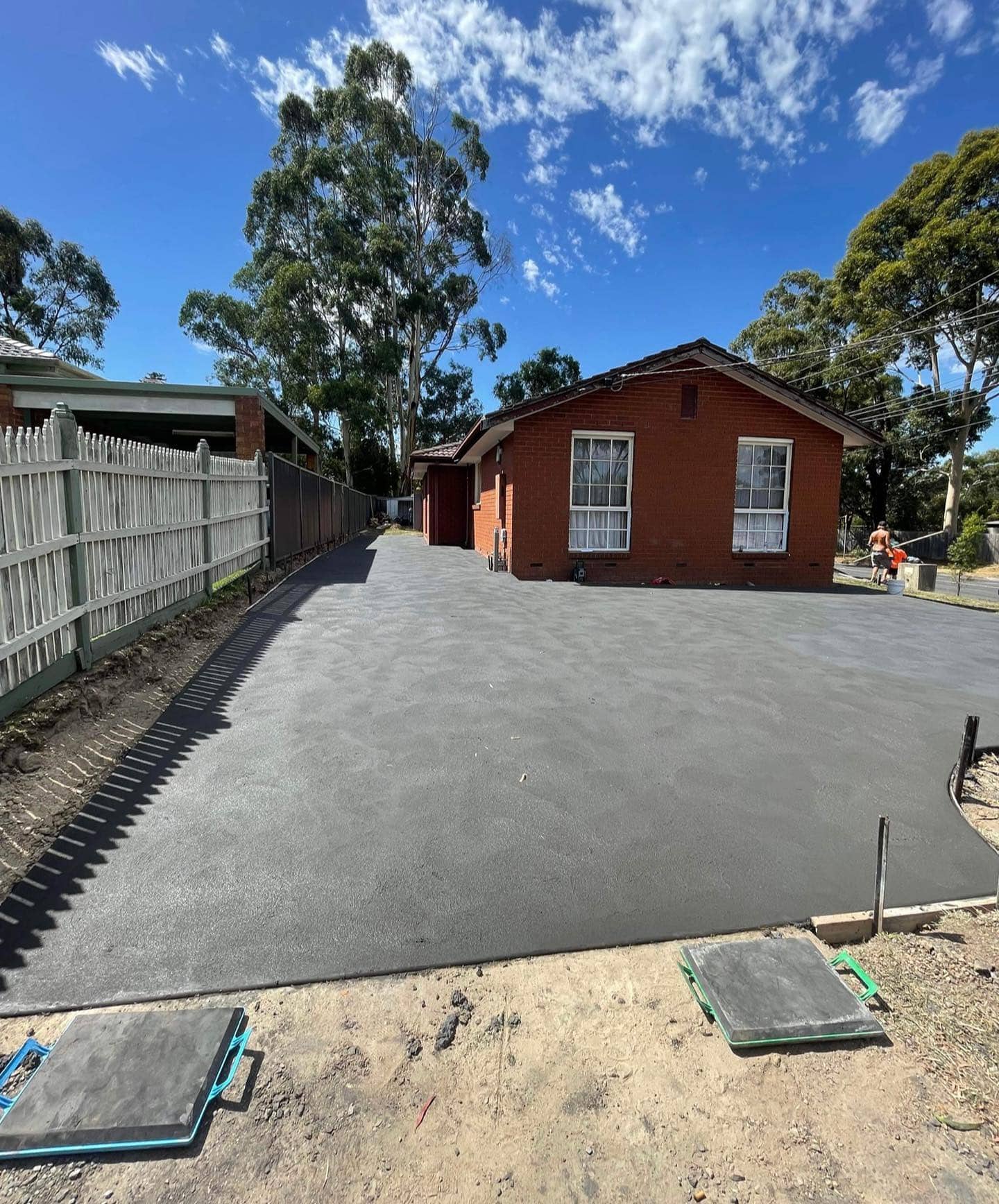
We pour new concrete across Heathmont — driveways, paths, slabs and entertaining areas — building each one for the site so it doesn’t crack or heave down the track. We’re a local team — we prep the base and reinforce the slab for the ground it sits on, so the concrete doesn’t crack or move down the track. Every site is different, so below is what shapes how we approach concreting in Heathmont.
Where we pour driveways and slabs in Heathmont
As a residential suburb ~24km east of Melbourne CBD in the City of Maroondah, Heathmont is an area we cover regularly. Our crews are often pouring new concrete in Heathmont, near Eastlink Trail (shared path along EastLink), Heathmont railway station and Heathmont shops (Canterbury Road).
Concrete doesn’t have to look plain. In Heathmont, in the eastern foothills, you can create stunning outdoor surfaces with the design flexibility and durability that concrete offers. From classic grey to custom colours, the possibilities are extensive.
Standard Grey: Timeless Appeal
There’s a reason standard grey concrete is everywhere—it works. It’s sophisticated, it suits any family homes in quiet streets, and it ages beautifully. A well-maintained grey concrete driveway or patio looks professional and understated.
Coloured Concrete: Personal Expression
Ready to express your style? Coloured concrete opens up endless possibilities. Consider textured finishes for safety and visual interest, warm earth tones that complement natural landscaping, or neutral greys that suit any architectural style. You can also add custom patterns and borders for unique character to combine safety and visual appeal.
Designed for Heathmont
The leafy residential suburb with bushland corridors environment of Heathmont lends itself perfectly to creative concrete design. The mixed clay and rock substrate here provides a stable base once properly prepared. Properties throughout Heathmont and nearby Ringwood East and Ringwood showcase concrete’s versatility—from classic to contemporary.
Expert Installation
Whether it’s a residential driveway or a commercial concrete project, Nupave has the experience to deliver quality results. We work with you to understand your design goals and deliver concrete surfaces that match your vision with uncompromising durability.
Does your concrete need replacing? If your existing surfaces are tired, worn, or damaged, we can start fresh with new concrete that matches your current design vision. Sometimes that means full replacement—other times, if the foundation is solid, resurfacing refreshes your appearance without the full cost.
Visit Nupave to explore design possibilities for your Heathmont property.
Concrete Services in Heathmont
Frequently Asked Questions
How much does concrete cost compared to pavers?
Concrete is generally more cost-effective than pavers, especially for larger areas like driveways. It also requires less ongoing maintenance, making it better value long-term for Heathmont properties.
Can concrete handle Melbourne’s weather?
Concrete is ideal for Melbourne conditions. It handles Melbourne’s variable rainfall, summer heat, and occasional frost without the cracking, warping, or rotting that affects timber and some other materials.
How long does a concrete pour take?
Most residential concrete jobs in Heathmont take one to three days depending on size and preparation needed. A standard driveway is typically poured in a single day, with curing time of around seven days before vehicle use.
Heathmont’s leafy streets and sloping blocks mean a lot of stepped driveways and textured paths that are tricky (and expensive) to replace. Our concrete resurfacing in Heathmont follows every contour of the existing slab with a fresh decorative layer. One of our steady suburbs in the City of Maroondah.